Table Of Content

Colored in one of four pastel shades — maize yellow, dove grey, surf blue, or desert tan — Lustron siding gives these houses their distinctive look. William J. Levitt was also a returning veteran, but, being the son of real estate investor Abraham Levitt, he took advantage of the GI Bill in a different way. In 1947, William J. Levitt joined forces with his brother to build simple homes on a large tract of land on Long Island, New York. Mass-produced tract housing developments called Levitttown welcomed the white middle class with open arms. Accessories are the finishing touch that can truly bring the vintage vibes of the 1930s to life in your home.
#18 Armstrong Asian-themed kitchen, 1935
In this case, the large mirror is complemented by beautiful lights hanging from a white ceiling and retro nightstands on each side of the bed. If you want to add subtle Art Deco elements to a minimalist, traditional, or Scandinavian design, this could be a safe bet. Many interiors made their debuts at expositions, like this Gilbert Rohde–designed living room, which was on display at Design for Living at the 1933 Century of Progress Exposition in Chicago. The era saw stunning job losses—15 million-plus people were unemployed by decade's end — and foreclosures, forcing millions to lose their homes.
Prefabricated Houses
The interior design aesthetic was heavily influenced by the counterculture or hippie movement of the time. Psychedelics found their way into the home through design and offered a visually shocking alternative to the practicality of midcentury modern design. Bright and bold colors and patterns ended up on walls, furniture, floors, and ceilings. Interior design trends have been heavily influenced by current events and economic trends. The 1920s were a time of prosperity and excess, which brought a more glamorous and over-the-top interior design style.
#45 Pabco kitchen design, 1939
Art Deco, on the other hand, made use of straighter, geometric, and more streamlined shapes. From the sleek lines of the modern movement to the revered forms of historic styles, you’ll see how these designs innovated living spaces. In the early 1930s, Art Deco furniture, created by designers like Emile-Jacques Rulhmann, had sleek surfaces and used modern materials like chrome and Bakelite, a type of plastic. It also tended to be rectilinear, or focused on geometric shapes and a vertical emphasis. Streamline Moderne sofas and couches in the 1930s living rooms represented the furniture of the era.
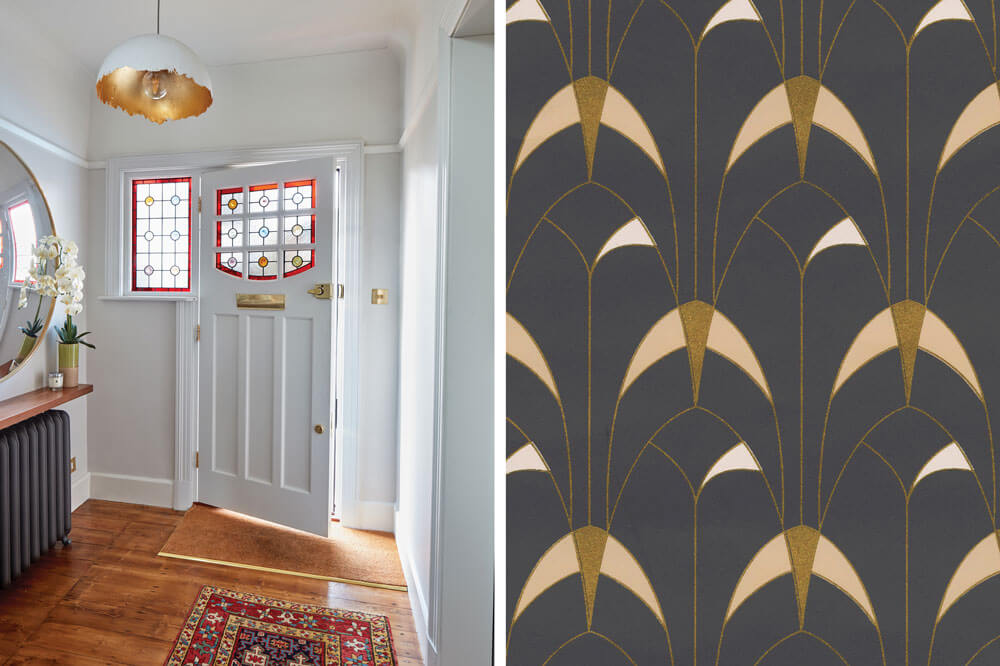
The design style made its way into other features of the majority of homes, including living room furniture that often consisted of curios and gramophones. Gramophones, which are older types of record players, and curios, which are cabinets used to store china with glass in front, were also designed in both the Art Deco and Streamline Moderne styles of the time. It was known for its celebration of the modern world through art, architecture, and even furniture. Bold colors such as black, silver, and gold were used to contrast each other while modern materials such as chrome, glass, and Bakelite (a type of plastic) were used to represent the Industrial age. For a touch of glamour, homeowners favored deep, rich colors—royal blues, lush greens, and radiant reds. Wallpaper often featured these hues, along with the striking geometric designs characteristic of the era.
Carefully Selected Colors for a Girl’s Room
This design philosophy, which had begun in the 1920s, took a firm hold on architecture and interiors in this era. The Art Deco movement, characterized by its geometric shapes, bold outlines, and lavish materials, found its way from grandiose buildings into the home. The 1930s were a defining era, not just in the world of fashion, politics, or cinema, but also in the realm of home décor and interior design. It was a decade marked by economic challenges due to the Great Depression, yet it sparkled with a distinctive style that homeowners embraced with open arms. Delving into the house interiors of the 1930s, we uncover a world where scarcity inspired creativity, and modern trends mingled with traditional comforts. When it came to lighting, a chandelier in the dining room or entrance could act as a statement piece, combining both function and decoration.
#17 Yellow kitchen by Sealex, 1934
Many people also suggest that the Civil Rights Movement was advanced by the struggle to integrate the all-white neighborhoods built by Levitt & Sons. Pastel hues from pink to green to blue punctuated interior home design in the 1980s. This circa-1985 bathroom's pastel floral motif on both the wallpaper and shower curtain complements the blue shower tile and matching pastel accent towel and bath towels. For example, in suburban areas, 1930s bungalows are highly sought after for their larger lot sizes and classic architectural features. To improve energy efficiency, you may need to invest in upgrading insulation in the walls, roof, and floors.
A 1930s Manhattan Duplex - Interior Designer Frank de Biasi - House Beautiful
A 1930s Manhattan Duplex - Interior Designer Frank de Biasi.
Posted: Thu, 30 Mar 2017 07:00:00 GMT [source]
Design’s influence from each time period can be seen in art, film, and architecture—and inevitably trickles down into homes and everyday lifestyle choices. No 1930s or 1940s design scheme would be the same without this era’s iconic vibrant, cheerful color palettes. Kitchens of this time period were often seen in two-tone color palettes, with both colors repeating throughout the space in different patterns for floor or wall coverings or as an appliance finish. Popular color choices included cherry red, pink, deep blues, white, bright yellow, and a wide range of green tones. The overall feeling of sentimentality and a brighter outlook for the future was evident in many interior design trends, including the style of the kitchen.
Streamlined furniture and a lack of clutter characterized homes, with innovation steering design towards more efficient, technology-friendly environments. Your appreciation for minimalism and functionality might stem from the Bauhaus influence, a German movement predicated on the blend of arts, crafts, and technology. Though World War II began at the end of the 1930s, its looming prospect influenced design, with a lean towards simplicity and durability.
Despite the solid craftsmanship of 1930s houses, they may require updates to accommodate modern technology. Electrical wiring may need upgrading to handle today’s gadgets and appliances safely. Moreover, you might have to consider adding modern amenities, like high-speed internet access or smart home technology, which require both wiring and wireless capabilities.
Whether it’s through the use of symmetrical patterns in a wallpaper or the streamlined form of a lamp, you’re not just decorating; you’re infusing your space with history and character. By doing so, you honor a pioneering era of interior design and its enduring legacy. Your appreciation for 1930s interior design may stem from recognizing how designers of that era ingeniously balanced cost-effective production with visually stunning aesthetics. In your own space, embracing the simplicity and grace of 1930s design can create a sense of tranquility and order. In embracing 1930s interior design, it’s important to focus on practicality and affordability while mixing the charm of old pieces with new, functional designs.
This furniture, made by designers and companies like Heywood-Wakefield, was made of materials like chrome and tubular steel. Objects were sleek and smooth with minimal decoration and featured shapes like torpedoes. Surfaces were smooth and sleek with minimal design and often incorporated modern materials like chrome and tubular steel. Companies like Heywood-Wakefield from New England made wooden furniture in a streamlined design in 1937.